The Model Can Reason. The API Must Govern.
A premium look at why AI security belongs at the API layer, not inside large language models.
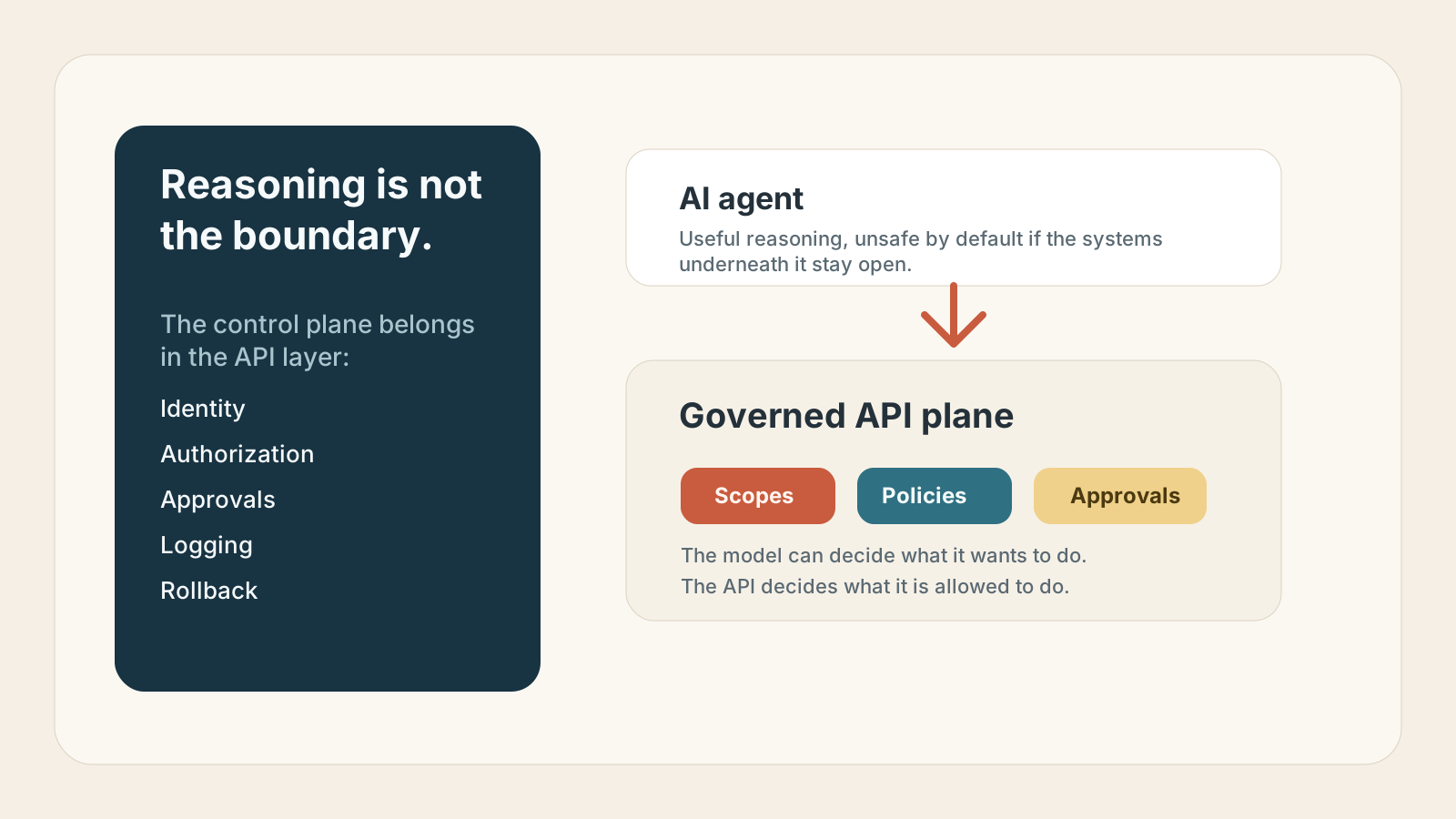
We are talking about AI security in the wrong place. Everyone is worried about hallucinations, prompt injection, rogue agents, and insecure outputs. Fair enough — those risks are real. But the real enterprise security boundary should not live inside the language model.
It should live in the APIs.
An AI agent should never be trusted because it sounds confident. It should be constrained because the systems underneath it enforce identity, permissions, approval flows, validation, logging, and rollback.
A hallucinating agent with broad, ungoverned API access is a control failure.
If an AI agent wants to approve a refund, the refund API should decide whether that action is allowed. If it wants to access employee records, the HR system should enforce role‑based access. If it wants to modify a purchase order, the ERP should require the same controls it would require from a human employee, a script, or any other automation.
Where the Boundary Actually Lives
The current dominant approach secures only the model layer — system prompts, content filters, output sanitization. The execution layer beneath it is often left open, legacy, and ungoverned.
The Anatomy of a Governed API Layer
Securing the execution layer is not one decision — it is a stack of coordinated controls. Each layer below handles a distinct concern. Skip any one of them and you have a gap an agent can fall through.
The Governance Gap Nobody Owns
This is where the post needs to go further than the technical checklist. The governance gap is not just a technology problem. It is an organizational one.
Before deploying agents into production workflows, someone needs to own three things explicitly: the agent's identity and credential lifecycle, the scope of API permissions that agent is allowed to invoke, and the approval and audit trail for any write operation it performs. Without explicit ownership, none of these get done.
Tools to Build This Today
The good news: most of the building blocks exist. The governance layer is an integration and discipline problem, not a missing technology problem. Here is the current tooling landscape, organized by function.
API Gateway & Policy Enforcement
Authorization & Policy‑as‑Code
Identity & Credential Management
Human‑in‑the‑Loop & Approval Workflows
Audit Logging & Observability
Where to Start
Before investing another million dollars into frontier models, invest in the integration layer. Modernize the APIs. Fix the permissions. Clean up the process boundaries.
- Audit every API an agent can reach — document what it does, who else calls it, what happens if it is called incorrectly
- Assign a named owner to agent identity and credential lifecycle — not a team, a person
- Implement OPA or equivalent for every write operation an agent can perform
- Add human approval gates to any action that moves money, modifies personnel records, or changes a system of record
- Emit structured logs from every agent API call — agent ID, action, scope, outcome — and route them to immutable storage
- Test your rollback path before an agent ever touches production
AI only tells them what to do.
Because an AI agent without a governed API substrate is just a brilliant brain with no hands.
And sometimes, worse: a brilliant brain with hands it should never have been given.