Beyond Rules: What a Good WAF Should—and Could—Be
The WAF category has gone stale. Its value now depends on the hardening, contextual intelligence, and pre-disclosure virtual patching built around it—not the generic rules engine carrying the WAF label.
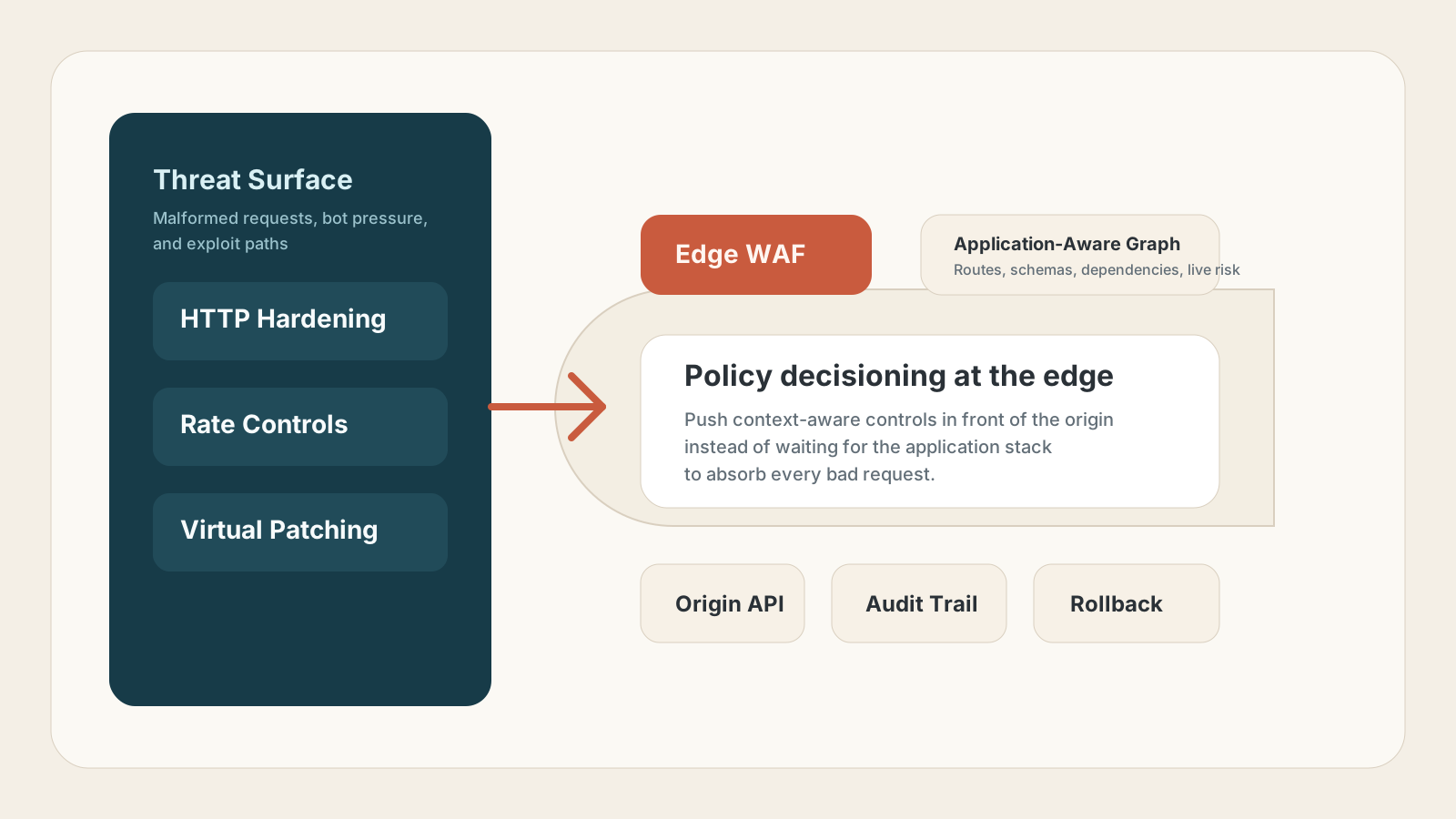
As applications migrate from monolithic backend servers to global edge functions, the surface area for cyberattacks increases exponentially. Legacy firewalls that sit in central datacenters are no longer sufficient.
Does your WAF have a rule to protect against a 10-year-old WordPress vulnerability when your application actually runs on NuxtJS? If the answer is yes, that is not a sign of intelligence. It is a sign that the control layer is generic, noisy, and disconnected from the application it is supposed to protect.
To protect modern APIs, we need to be clear about what a Web Application Firewall (WAF) is actually for. A WAF is not just a rules engine that blocks a few obvious attack strings. At its best, it is a hardening layer in front of your applications, APIs, and delivery stack that reduces exposure before bad traffic ever reaches vulnerable code.
The next step is making that protection application-aware. A strong edge security layer should understand your live routes, exposed methods, dependency tree, and runtime behavior through what is effectively an application-aware dependency graph. That is how you stop defending everything equally and start defending what is actually real, reachable, and relevant in your stack.
Why I Am Writing This
The uncomfortable starting point is that the WAF category has become stale. There has been remarkably little fundamental innovation in the core model: inspect an HTTP request, compare it with a collection of rules, assign a score, and allow or block it. Vendors have improved scale, deployment, and management, but the protection is still only as good as the hardening and rules placed around that engine.
Run a generic vulnerability scan against an application and the WAF result will mostly tell you which protections have been configured. It does not prove that the system understands the application. A clean scan can mean that the relevant payload matched a rule; it says very little about an unknown route, an unexpected state transition, a dependency-specific exploit, or business logic that is perfectly valid at the HTTP layer and still dangerous.
A WAF that does not know what it protects can only match what it already recognizes.
The more delicate value of an edge platform is often hidden below the WAF dashboard. It is in strict TLS behavior, consistent parsing and normalization, reverse-proxy architecture, origin isolation, header handling, request-smuggling resistance, and the continuous work of removing ambiguity from the attack surface. These controls are easy to overlook because they do not produce a dramatic block event, but they determine how much hostile input reaches the application in the first place.
Virtual patching is another place where the difference between platforms becomes meaningful. A mature security team may identify a vulnerability pattern and deploy a narrow protection before public disclosure or widespread exploitation. Customers benefit from those undisclosed virtual patches without ever seeing the work that happened upstream. The count, speed, precision, and relevance of those protections tell you more than the size of a generic managed-rule catalogue.
Oddly enough, a conventional WAF knows almost nothing about your code. It does not know which framework you run, which packages are loaded, which endpoints exist, which identities can reach them, or which sequence of otherwise valid API calls changes sensitive state. That has to change. The enforcement point can remain decoupled from the application, but its decisions cannot remain disconnected from application reality.
Threat intelligence alone does not solve the problem. A genuinely smart control would need multiple cyber-threat-intelligence sources, exploit observations, vulnerability data, code and dependency context, runtime signals, asset inventory, and application behavior. Many vendors already share indicators and attack signals across their platforms, which is useful. But a global indicator is still noncontextual until the system can explain whether it applies to this route, this dependency, this user, and this state transition.
Philippe Bogaerts reaches a compatible conclusion in “The WAF Is Dead. Long Live… What Exactly?”. Modern microservices, APIs, serverless functions, and agent-driven workflows have outgrown request-by-request perimeter inspection. Renaming a WAF to WAAP or adding an AI label does not create the missing runtime, identity, dependency, and workflow context.
I do not think the useful parts of the WAF are dead. Generic exploit filtering, protocol hygiene, virtual patching, and compliance controls still matter. What should die is the idea that a WAF-centric security model is enough. The rules engine should become one enforcement component in a wider application-security system that understands both the edge and the code behind it.
In practice, a serious WAF usually has three jobs:
- Protocol hardening and proactive defense: enforce sane HTTP behavior, reject malformed or abusive requests, and reduce the exposed attack surface through hardened configuration.
- Virtual patching: shield vulnerable paths quickly when a new issue is discovered, buying time before code fixes are fully built, tested, and deployed.
- Compliance and duty of care: demonstrate reasonable protection against common web attack classes such as OWASP Top 10 categories. In many environments, failing to implement these controls can be viewed as a serious governance and risk-management failure.
That framing matters, because the interesting question is no longer whether to run a WAF. The real question is what makes one WAF better than another, and what capabilities actually improve security outcomes instead of just satisfying a procurement checklist.
What Makes a WAF Good?
A weak WAF is mostly static signatures, generic OWASP rules, and a lot of manual exceptions. A strong WAF improves security posture in ways that are operationally useful:
- It hardens the protocol edge so malformed or abusive traffic never gets the same treatment as valid application traffic.
- It understands application context well enough to reduce false positives while still stopping real abuse.
- It supports virtual patching so newly discovered vulnerabilities can be mitigated immediately at the perimeter.
- It gives teams a cleaner path to compliance, auditability, and defensible security controls.
For modern APIs, that usually means moving the WAF closer to the edge and treating it as a zero-trust enforcement point instead of a passive regex filter.
The Pillars of an Edge-Native WAF
Traditional WAFs rely on "perimeter security": once a request is inside the network, it is trusted. In an edge-native Zero-Trust architecture, we assume every request is hostile until proven otherwise.
To enforce that model, the WAF evaluates three core pillars:
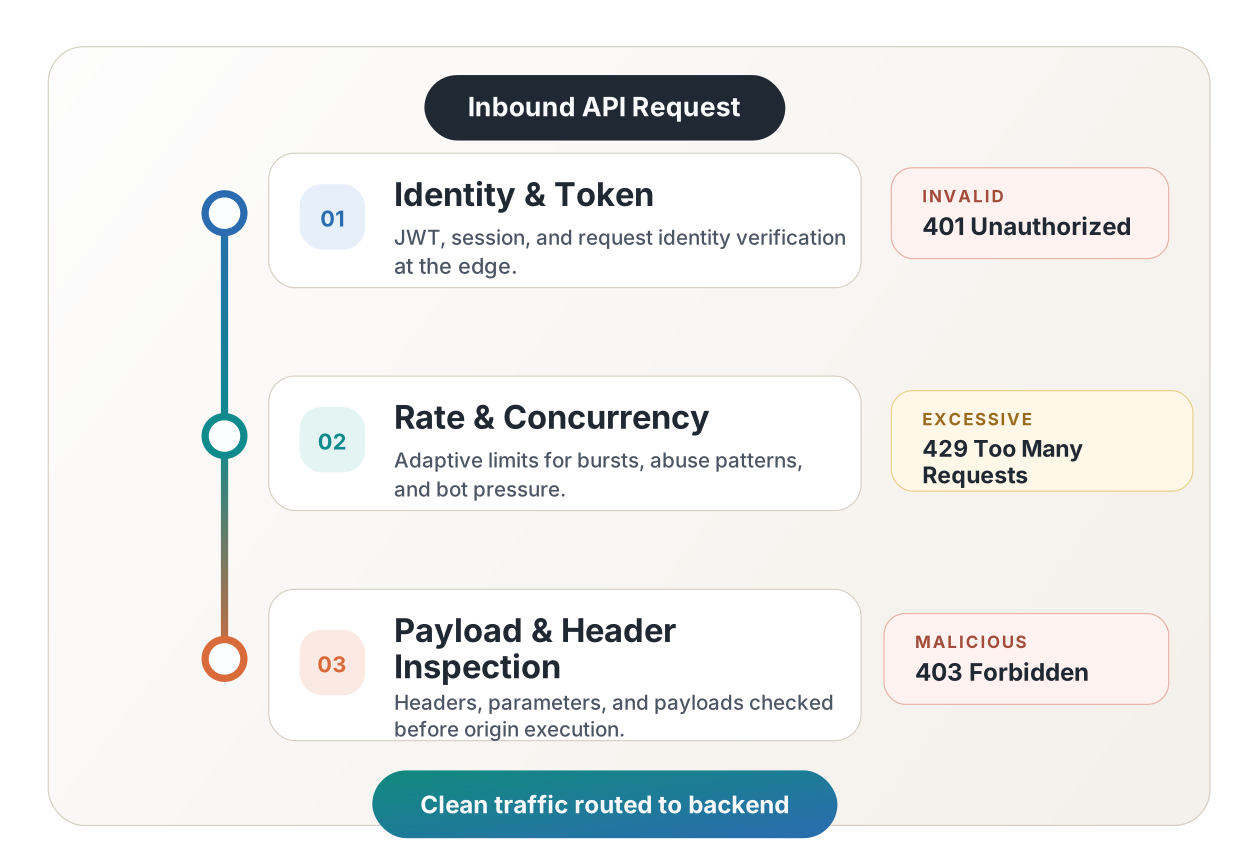
1. Hardening the HTTP Layer Before It Reaches Code
One of the most important things a WAF does is not glamorous: it makes the HTTP edge stricter.
This is where a good WAF provides proactive defense by:
- rejecting malformed headers, invalid methods, and suspicious protocol behavior
- enforcing normalized request handling so backend code receives fewer ambiguous inputs
- limiting exposed routes, methods, payload shapes, and origin-facing attack surface
- blocking obvious reconnaissance and abuse patterns before they become application problems
This kind of hardening matters because many real attacks are not sophisticated exploits. They are repeated attempts to abuse weak protocol handling, inconsistent parsing, and permissive application edges.
2. Identity, Session, and Request Verification at the Edge
To prevent unauthorized traffic from consuming downstream resources, verify authentication tokens (JWTs) directly in the edge function.
By utilizing lightweight crypto libraries native to edge runtimes (like crypto.subtle in Web APIs), we can verify signatures in less than 1 millisecond without making database round-trips:
// Edge JWT Verification function
async function verifyJwt(token, secretKey) {
  const [headerB64, payloadB64, signatureB64] = token.split('.');

  // Re-encode signature to verify
  const signatureBuffer = base64ToBuffer(signatureB64);
  const dataBuffer = new TextEncoder().encode(`${headerB64}.${payloadB64}`);

  const isCorrect = await crypto.subtle.verify(
    'HMAC',
    secretKey,
    signatureBuffer,
    dataBuffer
  );

  return isCorrect;
}
3. Dynamic Rate Limiting and Abuse Control
Rate limiting protects APIs from credential stuffing and scraper bots. However, static rate limits are easily bypassed by distributed networks.
Modern edge rate limiters utilize a Sliding Window Log algorithm with high-speed edge-side state and counters. We can track requests dynamically by:
- IP Reputation: Adjust limits based on the client's ASN (Autonomous System Number) or VPN status.
- Client Fingerprints: Combine TLS signatures (JA3 fingerprint) with HTTP headers to identify bots that rotate IPs.
4. Virtual Patching and Context-Aware Inspection
Virtual patching is one of the clearest reasons a mature WAF is worth the effort. When a new vulnerability appears, the fastest responsible response is often to shield the vulnerable path immediately at the edge while engineering teams work on the underlying code fix.
Traditional WAFs rely on static signature matching (regular expressions) that look for generic SQL Injection (SQLi) or Cross-Site Scripting (XSS) patterns. This leads to massive maintenance overhead and frequent false positives, like carrying protection for a decade-old WordPress issue when the application in front of you is a NuxtJS service with a completely different attack surface.
Next-generation edge security is decoupled from the application, but fully code and context aware. By linking the edge WAF with your application's active routing table, dependency manifests, runtime schema, and vulnerability intelligence into an application-aware dependency graph, the firewall dynamically adapts:
- Route Awareness: The WAF understands all valid paths and expected input shapes. Requests targeting non-existent endpoints or sending malformed structures are rejected at the edge.
- Dependency & Vulnerability Intelligence: The WAF has real-time awareness of your codebase dependencies. It dynamically hardens your perimeter against active CVEs in your dependency tree while ignoring irrelevant exploits (e.g., no SQLi filtering for a WordPress site if you run a purely document-based Node.js stack).
- Virtual Patching Harness: Instead of maintaining fragile regex rule sets, developers use the edge firewall as a harness to virtually patch applications, shielding vulnerable code path perimeters instantly without waiting for full code deployments.
5. Compliance, Auditability, and Reasonable Defense
Today, many organizations do not deploy a WAF just because it is technically helpful. They deploy one because it is part of baseline security expectations.
A WAF helps demonstrate that you are taking reasonable steps to defend against known classes of web attack, including many risks commonly mapped to OWASP Top 10 categories. It also helps create the evidence trail security teams, auditors, customers, and regulators increasingly expect:
- documented protection at the HTTP and API layer
- policy enforcement on common attack classes
- visible rate limiting, logging, and blocking decisions
- a defensible story for why known web risks were actively managed
That does not mean a WAF alone guarantees compliance or eliminates legal exposure. But not having one, or having one configured so weakly that it provides no meaningful control, can create an obvious gap in your security posture.
Conclusion
The value of a WAF is not that it blocks a few bad payloads. The value is that it hardens your HTTP edge, reduces exposed attack surface, buys time through virtual patching, and gives your organization a more defensible security baseline.
What separates a strong WAF from a weak one is everything layered on top: context awareness, adaptive rate controls, identity verification, cleaner protocol enforcement, better virtual patching, and better operational evidence. Running it at the edge ensures malicious requests are dropped close to the source, preserving backend compute cycles and reducing operational cost at the same time.