Cloudflare Agents Week
Cloudflare’s completed 2026 Agents Week points to a larger strategy: secure the agentic enterprise network while becoming the platform startups choose to build and operate AI-native products.
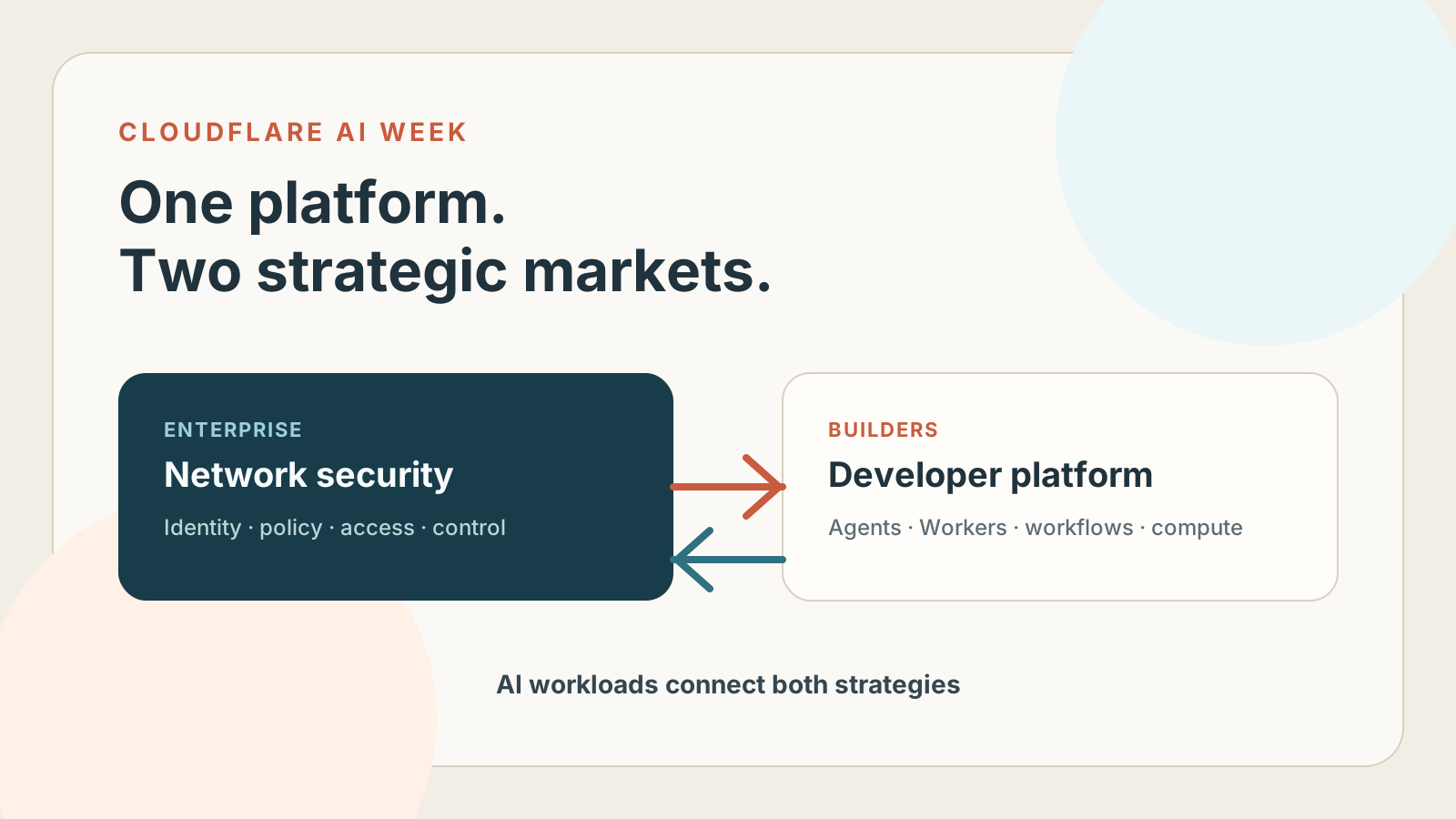
Cloudflare’s 2026 Agents Week is over, and the completed announcement set is easier to read as a strategy than as a feature week.
The company did not only announce new agent tools. It used the week to argue for a broader platform position: Cloudflare wants to secure the enterprise networks agents will operate across, and it wants developers and startups to build those agents on Cloudflare before their infrastructure choices harden elsewhere. AI is the workload connecting those ambitions.
A recent conversation about Cloudflare Connect in Sydney reinforced that interpretation. I was told that two themes received particular attention: enterprise network security and the developer experience for startups. That is secondhand feedback rather than an official event summary, but it matches the direction of the products Cloudflare announced during the week.
Cloudflare’s own recap framed the work around an “Agentic Internet” where agents need identity, communication, orchestration, memory, observability, and security. That is the important clue. Cloudflare is not presenting agents as a feature attached to one product line. It is presenting them as a new class of actor that changes what networks, applications, websites, and developer platforms need to provide.
AI agents turn infrastructure into a security problem
Cloudflare describes an agent-native web in which software acts on behalf of users, calls APIs, runs code, uses tools, stores state, and eventually makes payments. Every one of those actions crosses a trust boundary.
That makes enterprise network security more important, not less. An agent needs an identity. Its access should be scoped. Its traffic needs inspection and policy enforcement. Sensitive actions may require approval, and every decision needs enough telemetry to reconstruct what happened later.
The announcement of Cloudflare Wallets makes this especially concrete. Giving agents programmable payments and verifiable identity through the x402 protocol creates useful commercial possibilities, but it also increases the cost of weak authorization. An agent that can spend money or buy access to an API cannot be governed only through a prompt and a model’s best intentions.
The late-week security announcements made the same point from another angle. The Agent Access Model puts agents inside the same problem space as users, devices, applications, and service accounts: they need identity brokering, continuous mediation, and task-scoped access. Identity-aware AI Gateway extends that into AI usage itself by attaching verified user identity to model traffic and building behavioral baselines for people and agents. User Insights is as much a governance product as an observability feature, because the hard question is no longer just “what model was called?” but “who or what caused this behavior, and is it normal?”
That matters because rogue agent behavior will often look like legitimate access used at the wrong scale, at the wrong time, or for the wrong purpose. A service account that suddenly spends far more than usual, a coding agent that begins pulling unusually broad context, or an employee whose AI usage departs from their own baseline may not trip a static policy. It still changes the risk profile.
Cloudflare already operates across connectivity, application security, Zero Trust access, API protection, and edge execution. AI workloads give the company a reason to present those capabilities as one control plane: connect the agent, identify it, constrain it, observe it, and stop it when policy says no.
The enterprise pitch is therefore larger than “secure your chatbot.” It is about governing machine traffic as agents become another class of user on the corporate network.
The bigger developer-experience play
The other half of Agents Week was aimed at builders.
Cloudflare introduced an Agent Development Lifecycle, a unified Cloudflare Agents experience, local tracing that coding agents can inspect, and a new @cloudflare/computer runtime that can move between isolates and full Linux containers. It also announced cross-language Workers RPC, inbound TCP and gRPC support, programmable CI/CD building blocks, and an API for programmatic cost visibility.
Individually, these are product improvements. Together, they reduce the number of reasons a startup might leave the platform as its application becomes more complex.
A founder can begin with a Worker, add state and workflows, run agent code, call Python and JavaScript services through RPC, move a demanding task into a container, inspect traces locally, and monitor spend without immediately assembling a conventional cloud stack. That is a developer-experience strategy, not merely an edge-compute roadmap.
The late-week AI Gateway and Workers AI unification strengthens that argument. Cloudflare is collapsing the distinction between hosted inference and model-provider proxying into a single AI control plane with shared observability, billing, logging, and routing. The direction is clear: developers should not have to decide whether they are “using Workers AI” or “using AI Gateway” as separate choices. They should route model traffic through one path, see the cost and behavior in one place, and eventually let the platform make routing decisions by model, task, availability, and price.
That is strategically important because AI applications rarely stay simple. A prototype may use one hosted model. A production service may need fallback providers, managed GPUs, cost limits, logs, security policy, and routing logic. If Cloudflare can make that progression feel like configuration rather than re-platforming, it becomes more than an edge runtime. It becomes the operational layer around AI traffic.
The prize is the moment of platform selection. Startups make infrastructure choices early, when speed and simplicity matter more than procurement leverage. If Cloudflare becomes the easiest place to turn an agent prototype into a production service, it can capture workloads before they harden around AWS, Azure, Google Cloud, or a collection of specialized AI platforms.
The Agentic Internet is the broader thesis
The most interesting late-week material was not only about running agents. It was about how the web itself changes when agents become common visitors.
Cloudflare’s Agentic Internet framing is built around four ideas: readable, discoverable, callable, and payable. In plain terms, agents need to read web content efficiently, discover the right resources, call actions without scraping human interfaces, and pay for access or transactions when money is involved.
That pushes Cloudflare into a different strategic lane. It is not just selling infrastructure to application developers. It is trying to define the rules of engagement between publishers, merchants, domain owners, agent builders, and end users.
The pieces line up with products Cloudflare has been building for years. Bot management becomes agent identity and trust. CDN and security infrastructure become the place where domain owners decide which agents are welcome. Workers become an execution layer for agent-first browsing and tools. Wallets and x402 point toward paid machine interactions. AI Search, WebMCP, and Answer Engine Optimization aim at discoverability and callable actions rather than conventional page views.
This is also where the business-model tension becomes visible. If agents fetch content but never render ads, publishers need a different economic model. If agents interact with sites by guessing at forms and buttons, domain owners lose control and agents waste context. If only a few closed platforms own agent discovery, identity, and payment, the web becomes less open even if the content remains technically reachable.
Cloudflare is arguing for open rails where agents and sites can cooperate instead of collide. That argument is self-interested, but it is also coherent with Cloudflare’s position on the human web: sit in the middle, route traffic, enforce policy, improve performance, and make the messy transition look manageable.
MCP v2 makes the plumbing less heavy
The announcement of the next generation of MCP is easy to treat as a developer detail. It is more important than that.
MCP has become the common language for agents calling tools and services, but earlier remote deployments carried stateful session complexity. Cloudflare’s summary of the new MCP 2026-07-28 specification emphasizes the shift to a stateless core: no required protocol session, no required Mcp-Session-Id header, and no need to preserve a transport session for most tool calls.
That matters for Cloudflare because stateless HTTP workloads are exactly where Workers are strongest. A stateless MCP server can be deployed, scaled, secured, cached, logged, and governed more like an ordinary web workload. Durable Objects still matter when the application itself needs state, but MCP no longer has to impose statefulness just to speak the protocol.
The protocol changes also make security and operations more practical. Method and tool names can appear in headers, so gateways and policy systems can make decisions without parsing arbitrary JSON bodies. Authorization changes tighten the relationship between clients, issuers, and resource audiences. Multi-round-trip requests allow human approvals or missing input to be handled without keeping streams open.
In other words, MCP v2 turns a promising agent integration pattern into something closer to normal web infrastructure. That is useful for the ecosystem, and particularly useful for a company whose advantage is making global web infrastructure feel routine.
Dogfooding is part of the argument
Cloudflare is also trying to demonstrate that these abstractions can survive real workloads.
Its migration of cdnjs — a service handling roughly 9 billion requests per day — onto the Developer Platform is useful evidence. The company says the work pushed Workers and Workflows limits higher for everyone. Its account of using isolated AI subagents to reduce Astro’s open GitHub issue count, its internal use of AI to enforce engineering standards, and Cloudflare OS for internal agent-enabled work all serve a similar purpose: Cloudflare is presenting itself as a user of the agent-development model it wants customers to adopt.
Dogfooding does not remove the need for independent reliability data. A cache-heavy CDN, an issue-triage system, an internal work platform, and an enterprise agent application have different failure modes. But these examples are more persuasive than a synthetic demo because they force the platform to encounter operational constraints.
Two markets that reinforce each other
The security and developer-platform strategies are not separate bets.
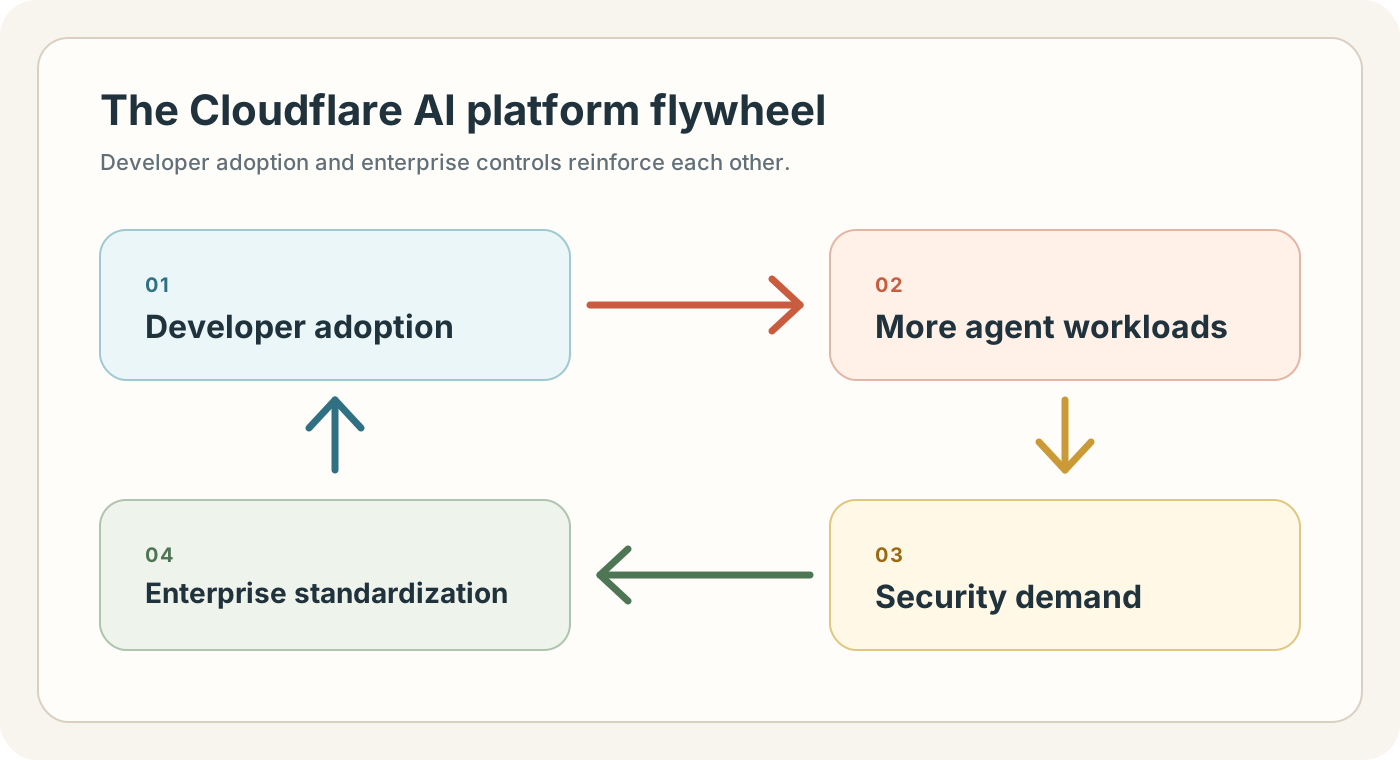
The more agent applications developers build on Cloudflare, the more valuable Cloudflare’s identity, network, policy, and AI-control-plane capabilities become. The more enterprises standardize on Cloudflare for connectivity and security, the easier it becomes for internal development teams to deploy Workers and agents inside an approved control plane.
That creates a potentially powerful loop: developer adoption brings workloads, workloads create security demand, and enterprise controls make the platform safer to adopt for more consequential applications.
It also creates tension. Developers will expect transparent pricing, excellent local tooling, portable interfaces, and predictable behavior under failure. Enterprise buyers will expect strong isolation, auditability, policy integration, support, and clear responsibility when an autonomous system causes harm. Publishers and website owners will expect control over which agents access their content, how they are identified, and whether they pay.
Serving all of those groups is much harder than announcing features for each.
What I would watch next
The next stage will be measured less by announcement volume and more by whether Cloudflare can make the pieces feel like one dependable platform.
The signals worth watching are straightforward:
- whether agent identity and authorization integrate cleanly with enterprise policy;
- whether tracing follows an agent across models, tools, Workers, containers, MCP servers, and external APIs;
- whether costs remain understandable as applications combine many platform primitives;
- whether model routing becomes reliable enough that developers trust the control plane rather than writing their own fallback logic;
- whether startups can move quickly without accepting unnecessary lock-in;
- whether publishers and site owners get practical economic choices as agent traffic grows;
- and whether Cloudflare publishes enough reliability and security evidence for enterprises to trust agents with consequential work.
Agents Week makes Cloudflare’s direction clearer. The company does not only want to deliver AI traffic or rent inference capacity. It wants to secure the networks agents operate across, own the developer experience through which a new generation of companies builds them, and shape the open web protocols those agents use to read, act, and pay.
That is a much larger ambition — and a more strategically interesting one.
Sources
- Everything we launched during Agents Week
- Welcome to Agents Week
- The Agent Development Lifecycle has arrived on Cloudflare
- Introducing Cloudflare Agents
- Your agent needs a computer, not a container
- Announcing Cloudflare Wallets
- The Agent Access Model
- Catching rogue AI behavior with identity-aware analytics
- Building an open Agentic Internet: readable, discoverable, callable, and payable
- The next generation of MCP
- Unifying Workers AI and AI Gateway into a single AI control plane
- How Cloudflare enforces engineering standards using AI
- How Cloudflare built a software factory for Astro issue triage